TIPS, GUIDES & INSIGHTS
FOR LOCAL BUSINESSES
If a customer can't find you on Google, it doesn't matter how good your work is. Clariq
helps Canberra businesses rank higher across Google's regular search results and the Map Pack, so you're the name that shows up when someone nearby needs what you
offer, not a weaker competitor with a stronger online presence.
Practical advice on local SEO, Google Business Profile, and getting found by the
customers already searching for what you offer — written for business owners,
not marketers. No jargon, no fluff, just what actually moves the needle for a local
service business.
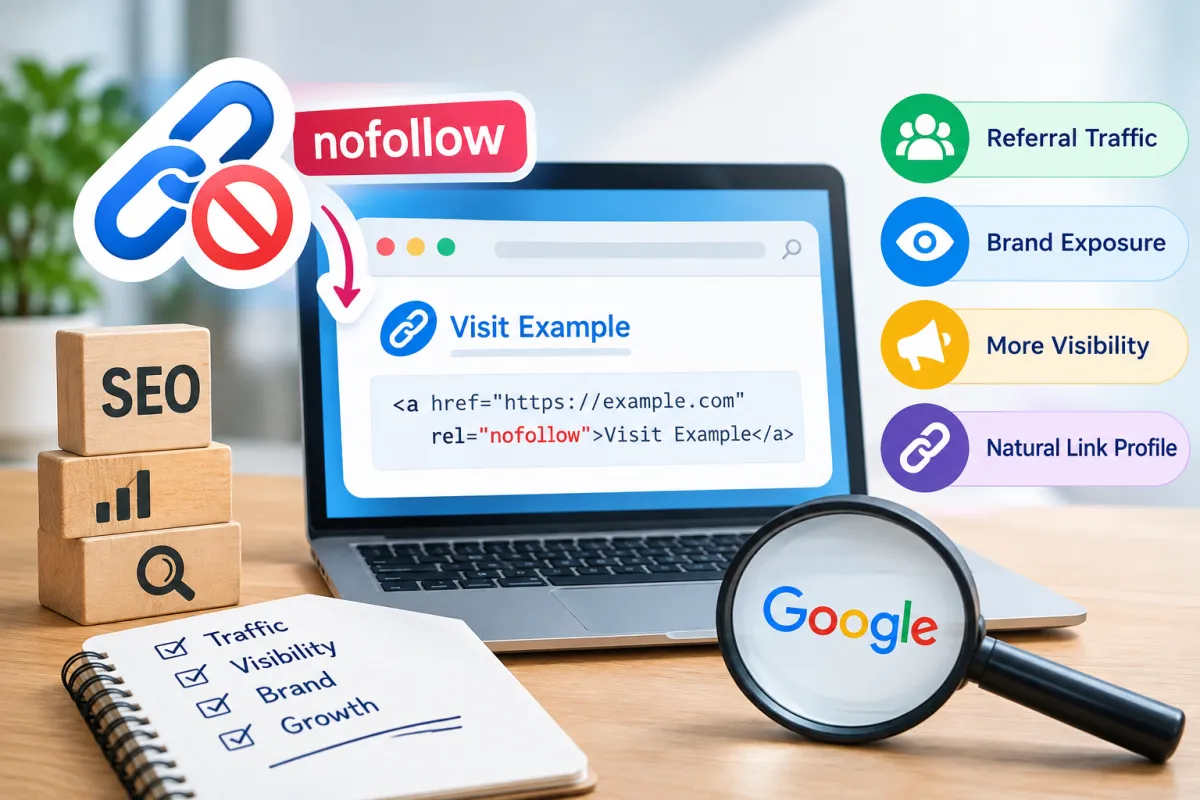
Do Nofollow Links Help SEO? Complete Guide for 2026
Do Nofollow Links Help SEO? The Complete Guide
Do nofollow links help SEO? Yes, they can help your website in several ways, but their SEO value is different from a normal followed link. A nofollow link generally tells Google not to treat the link as a normal editorial endorsement or pass ranking credit in the usual way. However, Google has clarified that nofollow is now treated as a hint, meaning Google may decide whether to use the link for crawling, indexing, or ranking purposes based on its broader systems and signals.
That distinction matters if you are building backlinks, managing a website, or evaluating your existing backlink profile.
Nofollow links can generate referral traffic, increase brand exposure, help people discover your business, and contribute to a natural and diverse backlink profile. They can therefore be useful even when their direct ranking impact is uncertain.
This guide explains what nofollow links are, how Google currently treats them, when they are useful, and how to use them without violating Google's search policies.
What Is a Nofollow Link?
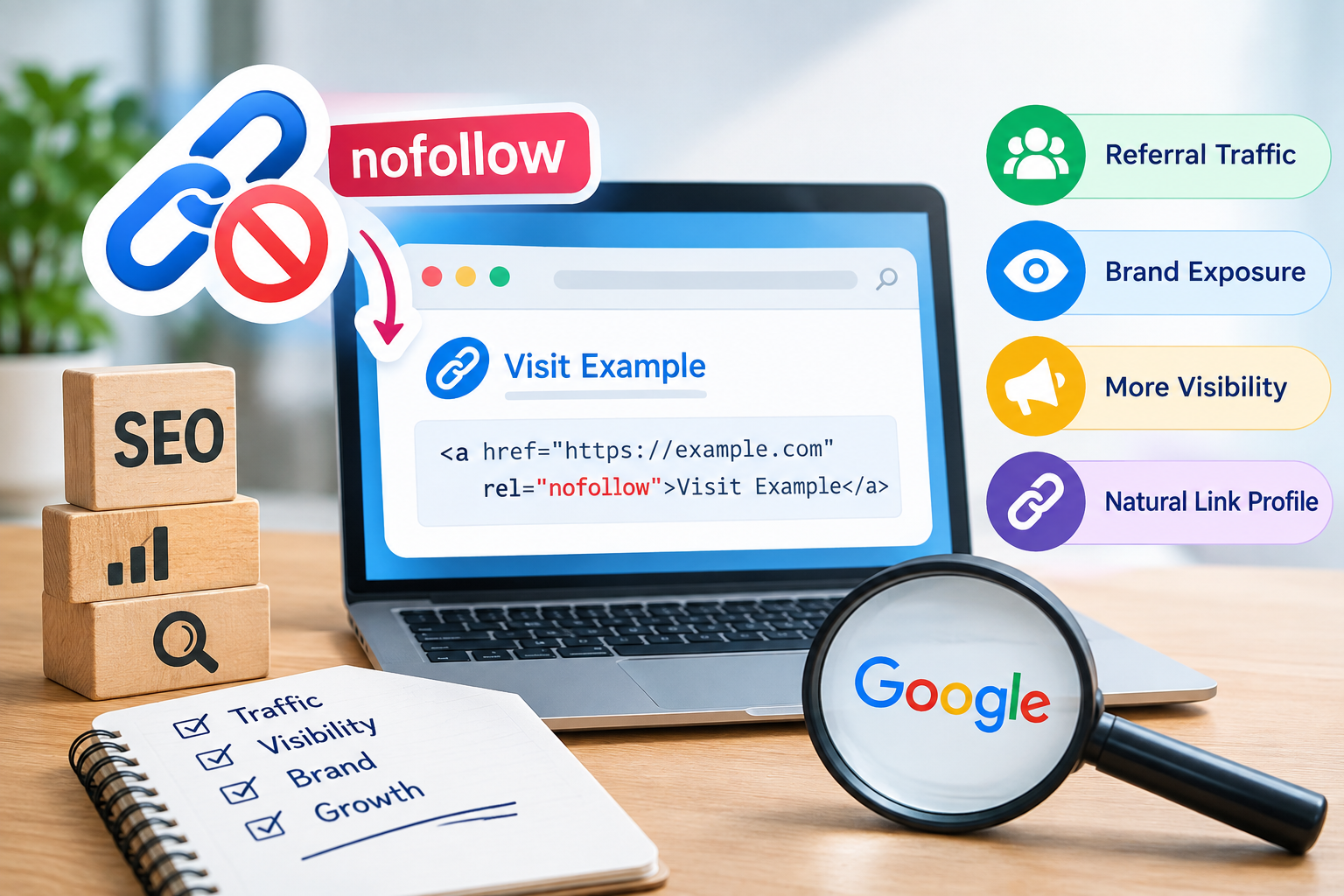
A nofollow link is a hyperlink containing the rel="nofollow" attribute.
For example:
<a href="https://example.com" rel="nofollow">Visit Example</a>The nofollow attribute tells search engines that the website owner does not want the link to be treated as a normal endorsement of the destination page.
Google introduced nofollow originally to help website owners deal with links they did not want to endorse, particularly links in areas such as comments and other user-generated content.
Google later introduced additional link attributes, including rel="sponsored" and rel="ugc".
According to Google Search Central, nofollow should generally be used when you do not want Google to associate your site with the linked page or when the other qualifying attributes do not apply.
Do Nofollow Links Help SEO?
The short answer is yes, but not necessarily in the same direct way as followed links.
Google changed its treatment of nofollow links in 2020. Rather than treating nofollow as an absolute instruction to ignore every aspect of the link, Google describes nofollow, sponsored, and ugc as hints about how links should be treated.
This means it would be inaccurate to say that every nofollow backlink has absolutely zero SEO relevance.
At the same time, you should not assume that a nofollow backlink passes the same ranking credit as a normal followed link. Google does not promise that it will transfer PageRank through a nofollow link.
The safest conclusion is:
Nofollow links can be valuable, but you should not build a strategy that depends on them passing ranking credit.
Their strongest benefits can come from traffic, visibility, brand discovery, audience exposure, and natural link-profile diversity.
How Google Treats Nofollow Links
Google's current documentation provides an important distinction between different types of links.
A normal editorial link can generally be left without a special rel attribute when the publisher is comfortable endorsing the destination.
For paid placements, Google recommends rel="sponsored".
For user-generated links, Google recommends rel="ugc".
For links that you do not want to associate your site with, rel="nofollow" can be appropriate.
Google also explains that these qualifying attributes are generally treated as hints. Therefore, website owners should not think of nofollow as a guaranteed technical wall that makes Google permanently ignore a URL.
This is one of the most important updates to understand when reading older SEO advice.
Nofollow vs. Follow Links
The main difference is how the link is qualified.
A normal followed link does not contain rel="nofollow", rel="ugc", or rel="sponsored".
For example:
<a href="https://example.com">Example</a>A nofollow link looks like this:
<a href="https://example.com" rel="nofollow">Example</a>Followed links are generally more important when your objective is to earn traditional link-based ranking signals. SEO platforms such as Ahrefs and Semrush therefore distinguish followed links from nofollow links when analyzing backlinks.
However, this does not mean that nofollow links are useless.
A link can have substantial marketing value even when it does not provide conventional ranking credit.
7 Ways Nofollow Links Can Help Your Website
1. They Can Send Referral Traffic
The most obvious benefit of a nofollow link is that people can still click it.
Suppose an industry publication, community website, forum, or social platform mentions your company and includes a nofollow link.
Someone reading that page may click the link and visit your website.
That visitor does not care whether the link is technically nofollow or followed.
If the referral produces a qualified visitor, lead, enquiry, subscriber, or customer, the link has delivered genuine business value.
For many businesses, this can be more meaningful than an uncertain theoretical ranking benefit.
2. They Increase Brand Visibility
A strong backlink strategy should not focus exclusively on rankings.
People need to encounter your business in multiple places before they become familiar with it.
A nofollow link on a relevant website can expose your brand to a new audience. If readers repeatedly see your company mentioned in appropriate industry contexts, your brand can become more recognizable.
This is especially useful for local businesses.
For example, a company working on local search visibility may benefit from being mentioned by relevant Australian business publications, local organizations, industry websites, or community resources.
A company such as Clariq, which focuses on local SEO, Google Business Profile management, web design, and lead automation for Australian service businesses, illustrates why visibility beyond a single Google result can matter.
3. They Can Diversify Your Backlink Profile
A natural backlink profile does not normally consist exclusively of one link type.
Real websites can receive links from social platforms, forums, publications, directories, articles, organizations, and other sources. Different platforms use different link attributes.
Consequently, seeing nofollow links in a backlink profile is not inherently a problem.
Ahrefs has also discussed the potential indirect benefits of nofollow links, including referral traffic and the diversification of a site's link profile.
The goal should not be to manufacture a specific ratio of followed to nofollow links. Instead, earn links naturally from sources that genuinely make sense for your audience and business.
4. They Can Put Your Brand in Front of Relevant Audiences
A nofollow link from a highly relevant website may be more useful to your business than a followed link from an unrelated, low-quality website.
Consider two hypothetical links.
The first comes from a respected publication read by your target customers but is nofollowed.
The second comes from an unrelated website created primarily to publish backlinks.
The first may generate meaningful visitors and brand recognition, while the second may provide little practical value.
Modern SEO should therefore evaluate the context and quality of the referring website, not just whether a backlink is labeled dofollow.
5. They Can Support Content Discovery
Google says links are important for discovering pages and understanding relationships between pages. At the same time, Google specifically says qualifying attributes such as nofollow are hints rather than absolute commands.
This means you should not assume that every nofollow link will be crawled or used as a ranking signal.
However, it is also incorrect to treat every nofollow link as completely invisible to Google's systems.
Your important pages should still have proper crawlable internal links and other discovery paths such as XML sitemaps where appropriate.
6. They Can Support Your Overall Marketing Strategy
SEO is only one part of digital marketing.
A nofollow link can contribute to:
referral traffic
brand awareness
audience growth
partnerships
reputation
content distribution
lead generation
direct conversions
These outcomes can be valuable even if the link provides no conventional PageRank benefit.
For example, a relevant article mentioning your business may introduce your company to potential customers who had never heard of you.
7. They Can Be the Correct and Safer Link Attribute
Sometimes the question is not whether you want a followed backlink.
The question is whether the link should be followed at all.
Google recommends qualifying paid links and user-generated links appropriately. Paid links can use rel="sponsored" or rel="nofollow", while user-generated links can use rel="ugc" or rel="nofollow".
Using the appropriate attribute is therefore part of responsible SEO.
Are Nofollow Links Better Than Dofollow Links?
Not necessarily.
The two link types serve different purposes.
A followed link is generally more useful when the objective is to earn traditional link-based ranking signals.
A nofollow link can be valuable for traffic, visibility, brand exposure, and other marketing outcomes.
The quality of the referring website also matters.
A followed link from an irrelevant or low-quality website should not automatically be considered better than a nofollow link from a highly relevant and trusted publication.
Backlinko's more recent backlink guidance similarly emphasizes relevance, source credibility, and editorial context rather than treating the dofollow/nofollow distinction as the only measure of backlink quality.
Should You Build Nofollow Backlinks?
Yes, but do not build backlinks simply because they are nofollow.
Instead, pursue legitimate opportunities that put your website in front of relevant people.
For example, a useful nofollow link can come from:
an industry publication
a relevant forum discussion
a community resource
a social platform
a legitimate business profile
a relevant organization
an editorial mention
user-generated content where the platform appropriately qualifies the link
The primary objective should be to create something useful for people, not to manufacture backlink numbers.
Can Nofollow Links Improve Google Rankings?
This is where you need to be careful.
There is no reliable rule saying:
“One nofollow link equals X ranking improvement.”
Google does not publish a formula that lets SEOs calculate ranking gains from individual backlinks.
Google's documentation says qualifying link attributes are hints, and its systems may choose how to handle them.
Therefore, it is reasonable to say that nofollow links can contribute to SEO indirectly and may potentially be considered by Google's systems, but it is not accurate to promise that a nofollow backlink will improve a particular keyword ranking.
This distinction is important for honest SEO reporting.
Do Social Media Links Help SEO?
Many social platforms use nofollow or other link qualifications on outbound links.
That does not make social media useless for marketing.
Social links can help people discover your business, visit your website, share your content, and become familiar with your brand.
The SEO benefit should therefore not be measured only by whether the social link passes ranking credit.
A successful social presence can generate exposure and traffic that support the broader marketing ecosystem around a website.
Do Forum and Comment Nofollow Links Help SEO?
They can provide value when they are genuine and relevant.
For example, if you answer a real question on a relevant community and your website is a useful additional resource, a reader may click your link.
But using forum comments primarily to distribute keyword-rich backlinks is a different practice.
Google explicitly identifies forum comments with optimized links as an example of link spam when they are used to manipulate rankings. Google also warns against low-quality directory and bookmark links created primarily for ranking manipulation.
The difference is purpose and quality.
A helpful contribution with a genuinely useful reference is very different from hundreds of automated comments containing commercial anchor text.
Can You Buy Nofollow Links?
Paid advertising and sponsorship are legitimate forms of marketing, but paid links must be properly qualified.
Google's spam policies explain that buying or selling links for ranking purposes can violate its link-spam policies. Google also states that paid links can be used for advertising or sponsorship when they are appropriately qualified with rel="nofollow" or rel="sponsored".
If you pay for a placement, do not assume that adding nofollow automatically makes every aspect of a manipulative campaign acceptable.
The content should still provide legitimate value, and the relationship should be represented accurately.
What About Guest Posts?
Guest posting can be legitimate when the primary purpose is publishing useful content for the host site's audience.
Problems arise when guest posts become a scaled link-building scheme.
Google specifically lists advertorials and guest posts containing links intended to pass ranking credit as potential examples of link spam, particularly when optimized anchor text is used to manipulate rankings.
A better approach is to choose publications because their audience is relevant and create original content that genuinely belongs there.
The link should be secondary to the value of the article.
Should Every Backlink Be Dofollow?
No.
Trying to make every backlink followed is neither realistic nor necessary.
Real websites naturally receive different types of links.
Google itself recommends using nofollow, sponsored, or ugc when appropriate rather than attempting to force every external link into a standard followed format.
Your goal should be a natural, relevant backlink profile, not an artificial backlink profile designed around a specific attribute ratio.
What Does Google Consider Link Spam?
Google defines link spam as creating links primarily to manipulate search rankings.
Examples include buying or selling links for ranking purposes, excessive link exchanges, automated link creation, low-quality directory or bookmark links, keyword-rich links placed in low-quality contexts, and forum comments containing optimized links.
This is particularly important for businesses investing in SEO.
Creating 1,000 low-quality backlinks is not automatically better than earning a handful of legitimate editorial mentions.
In fact, aggressive link manipulation can create unnecessary risk.
Google says sites that violate its spam policies may rank lower or be omitted from search results.
How to Use Nofollow Links Correctly
A sensible backlink strategy starts with relevance and usefulness.
First, create content worth referencing.
Second, promote that content to audiences that could genuinely benefit from it.
Third, accept the link attribute chosen by the publisher when it accurately represents the relationship.
Fourth, avoid automated backlink services and mass submission campaigns designed primarily to inflate backlink counts.
Finally, monitor your backlink profile, but do not panic simply because some links are nofollow.
The presence of nofollow links is normal.
Nofollow Links and Internal Linking
Nofollow should generally not be used as a blanket approach for your important internal links.
Google recommends creating crawlable internal links so that it can discover and understand important pages on your website. Google also recommends contextual internal linking and descriptive anchor text.
If you control your own website and want Google to discover an important page, a normal crawlable internal link is usually the appropriate choice.
For internal links, focus on logical site architecture and helpful navigation rather than trying to sculpt rankings with large numbers of nofollow attributes.
A Better Backlink Strategy in 2026
A modern backlink strategy should focus on quality, relevance, editorial context, and usefulness.
Instead of asking:
“How many dofollow backlinks can I build?”
Ask:
“Which websites are genuinely relevant to my audience, and why would their readers benefit from visiting my website?”
That shift produces a more sustainable strategy.
A relevant industry mention can create referral traffic.
A local publication can increase awareness in your service area.
A useful community contribution can generate qualified visitors.
A high-quality editorial reference can strengthen your website's authority and visibility.
The link attribute is important, but it is only one part of the picture.
Final Answer: Do Nofollow Links Help SEO?
Yes, nofollow links can help SEO and digital marketing, but you should not treat them as equivalent to normal followed links.
Google now treats nofollow as a hint rather than an absolute directive. That means Google may decide how to handle the link based on its broader systems. However, Google does not guarantee that a nofollow link will pass ranking credit.
The clearest benefits of nofollow links are often indirect: referral traffic, brand visibility, audience discovery, credibility, and a naturally varied backlink profile.
Followed editorial links remain important when you are trying to earn traditional link-based ranking signals. But obsessing over followed links while ignoring relevance and quality is a poor SEO strategy.
The best approach is to earn relevant, legitimate, editorially appropriate links and let the correct link attribute reflect the relationship.
Most importantly, avoid buying links for ranking manipulation, automated backlink generation, excessive link exchanges, low-quality directory submissions, and spammy forum comments. Google explicitly identifies these practices as potential link spam.
In other words, don't build backlinks merely to increase a number in an SEO tool.
Build useful content, earn legitimate mentions, reach relevant audiences, and let SEO benefits follow naturally.